
Solar Panels
Put your own daylight generation into your car with a solar-aware chargepoint.
Explore solar panelsEV Charging · Locally installed
A home EV chargepoint fitted where you park, with a tidy cable route and smart scheduling around your tariff. Surveyed and installed by our own engineers.
A dedicated home chargepoint is safer and faster than running your car from a three-pin plug. It is wired on its own circuit with the protection that long charging sessions need, and it puts a proper, weatherproof connection right where you park.
Most people find charging quickly becomes part of the evening routine: Arrive home, plug in, forget about it. A smart EV charger can schedule charging onto cheaper overnight electricity automatically, so the car is ready in the morning without you watching the clock. Charging speed still depends on the vehicle, the charger and your home’s supply.
Greater Lincolnshire
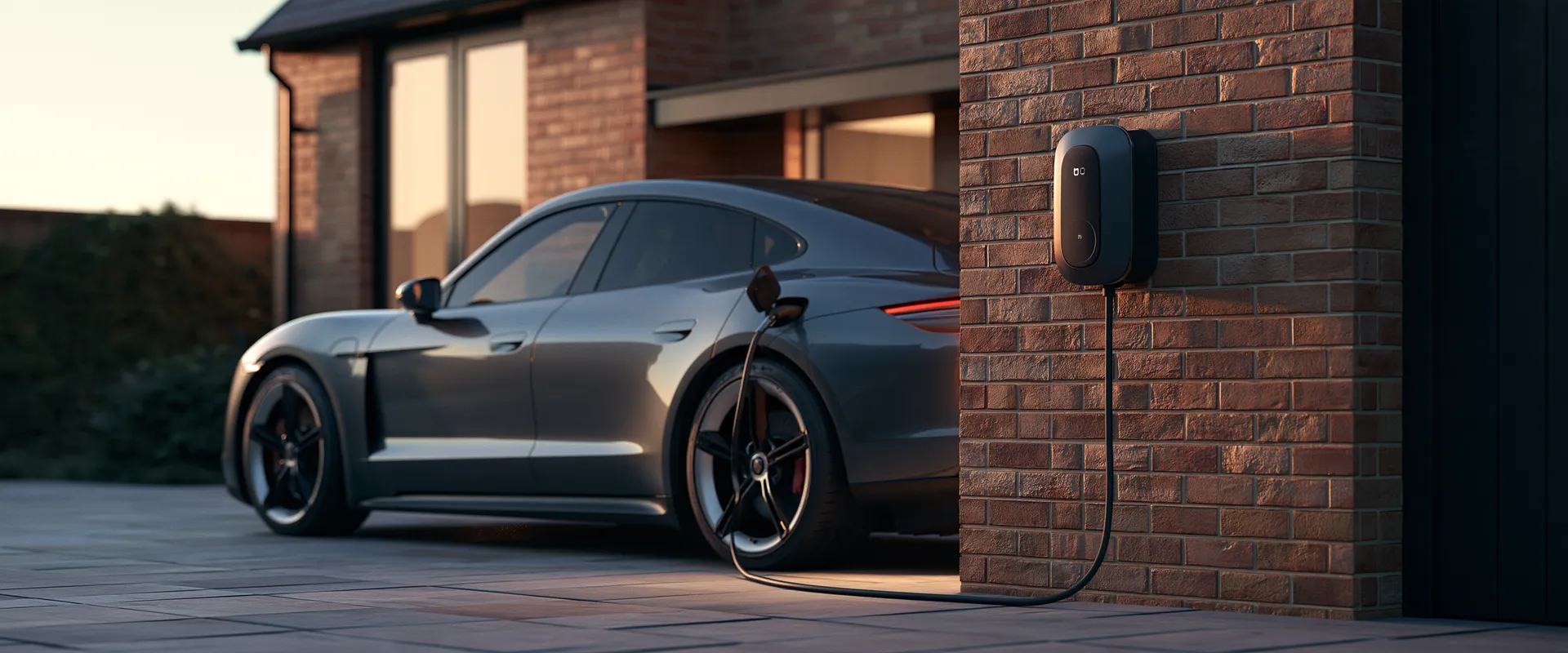
For semi-detached homes and bungalows with their own driveway — common in Grimsby, Lincoln, Scunthorpe and Grantham — a chargepoint is usually a straightforward job, with the unit on the house wall and a short cable run.
Terraced streets and shared parking, which you will find across Cleethorpes, Boston and Skegness, need more honest planning. We look carefully at where the car actually sits and whether a safe cable route exists. If a route isn’t practical, we’ll say so plainly rather than suggest a workaround that isn’t safe or permitted.
Newer estates in North Kesteven and West Lindsey were generally built with modern electrical installations, so there is often headroom for a charger — though we still check rather than assume.
It starts with a survey
A short visit tells us where the charger should go, what the installation involves and whether anything at your consumer unit needs attention first. You’ll know before you commit.
All installation is carried out by Townsend’s own engineers.
Costs, grants and support
It depends on the unit you choose and your property. A longer cable run, groundwork or upgrades at the consumer unit all add to the work, so the survey comes first and you receive an itemised quote.
Features vary between chargers: Tethered or untethered, smart scheduling, and solar-aware charging that prioritises your own generation. Off-peak overnight charging is usually the cheapest way to run an electric vehicle at home, so a charger that works with your tariff matters.
On EV charger grants: Current grants target renters and flat owners with off-street parking, and households with on-street parking installing cross-pavement solutions — we’ll confirm what applies to your property.
How it works
Four simple stages, usually with very little disruption to your home. Where the job turns out to be more involved than expected, we explain why before carrying on.
We confirm the parking position, cable route and electrical capacity.
We recommend a charger and settings that suit your car, your tariff and any solar.
Your itemised quote, set out clearly. Nothing is ordered or booked until you’ve accepted it.
Our own engineers mount the unit, run the cable and fit the circuit protection, then test everything and set up the app with you.
Looking after your system
A home chargepoint needs little day-to-day attention, but an occasional check keeps it safe and reliable. Needs vary by model and how exposed the unit is, so we’ll suggest a routine and quote for any service visits after the survey.
Common questions
Current grants target renters and flat owners with off-street parking, and households with on-street parking installing cross-pavement solutions. Most homeowners with a driveway are not currently eligible. Schemes change, so we’ll confirm the current position for your property when we quote.
A tethered charger has its cable permanently attached — convenient if you always use the same car. An untethered unit has a socket and you use your own cable; it looks tidier and suits households with different vehicles. Both charge equally well, so it comes down to habit and appearance.
A straightforward installation close to the consumer unit is a relatively short job. Longer cable runs, groundwork or electrical upgrades take more time. We’ll give you a realistic timescale after the survey, so you can plan around it.
Yes. A solar-aware charger can direct surplus generation into your car during the day. How much of your charging comes from the sun depends on the season, the size of your system and when the car is at home. We can design solar and charging to work together.
Most smart chargers can be scheduled to charge during cheaper overnight periods, and some connect directly with particular tariffs. We’ll check compatibility with your supplier and set up the schedule with you at handover.
Chargepoint installation involves specific wiring regulations, earthing considerations and notification requirements, so it is best handled by electricians experienced in EV work. Our own engineers carry out every installation, and we’ll explain the certificates you receive at the end.
A 7kW chargepoint charges considerably faster than a 3kW supply, which is why most home installations use one. Whether it is the right choice depends on your car’s onboard charger, how far you drive and your electrical supply. We’ll recommend what suits your routine.
Usually as close as practical to where you park, on a wall or post that keeps the cable off walkways. We balance convenience, a safe cable route and the look of your home, and talk through the options with you on site.
Works well together
Put your own daylight generation into your car with a solar-aware chargepoint.
Explore solar panelsPlanning a heat pump too? We’ll check your supply can comfortably handle both.
Explore heat pumpsStart here
Choose ev charging — and anything else you are considering — then answer a few questions about your home. We look at the whole home, not just the one system.
No pressure, no commitment — just a clearer starting point.
We install ev charging across Greater Lincolnshire. Popular areas:
Your next step
Share your plans and a few details about your home. We’ll review them and come back to you.
Plan your upgrade