
Battery Storage
Store the surplus your panels generate and use it after dark.
Explore battery storageSolar Panels · Locally installed
Solar panels planned around your roof and the way your household uses electricity. Installed by our own engineers, with honest advice from the first survey.
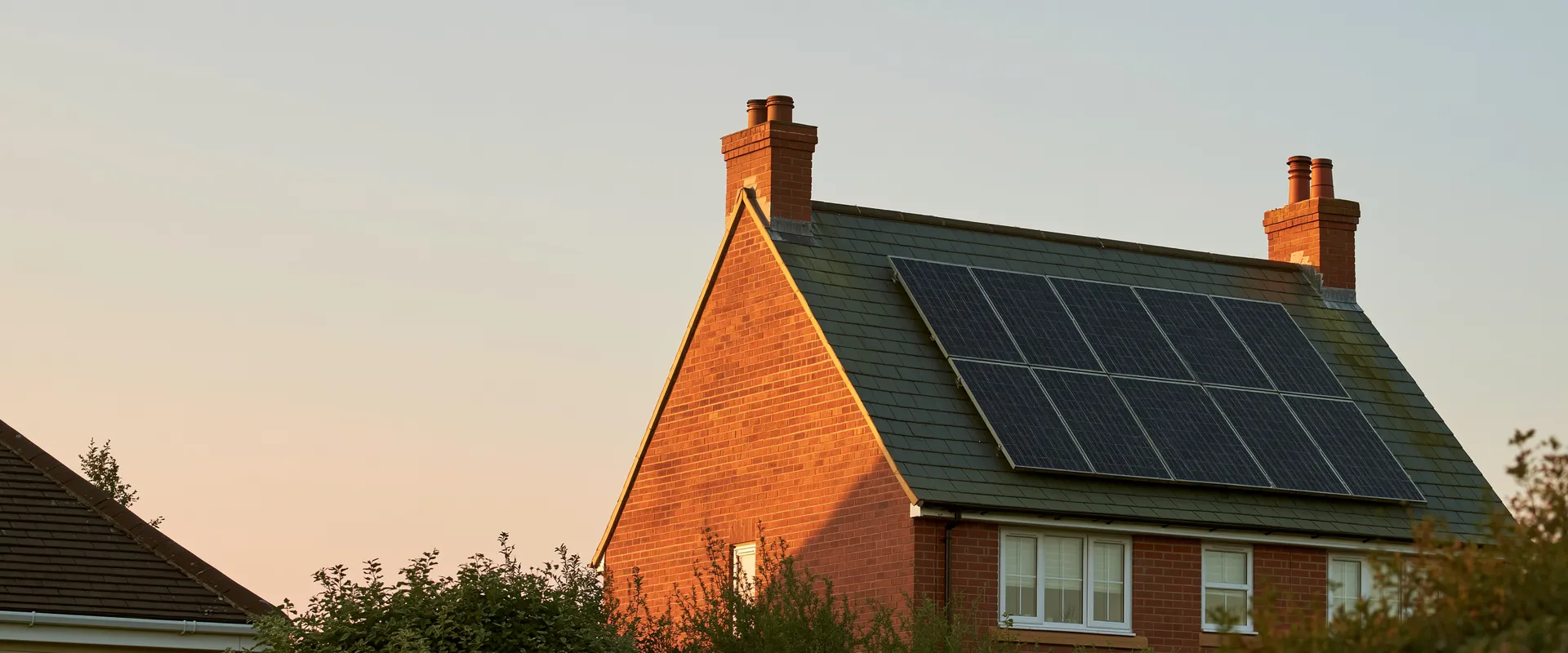
Solar panels turn daylight into electricity that your home can use straight away. When the panels produce more than you need — on a bright afternoon when everyone is out, for example — a battery can store that surplus so you can draw on it in the evening, when lights, cooking and screens all come on together. Without a battery, unused electricity flows back to the grid.
Output rises and falls with the seasons. Long summer days generate far more than short winter ones, so a well-designed system is sized for the whole year, not just its sunniest week. That is why we start with your roof and your routine rather than a standard package.
Greater Lincolnshire
Much of the housing across Greater Lincolnshire suits solar well. Semi-detached homes, terraces and bungalows often have generous, uncluttered roof slopes, and bungalows in particular can offer a large roof area relative to the size of the household.
Location shapes the conversation in different ways. On the coast, in Grimsby, Cleethorpes and Skegness, we think about wind exposure, salt air and how fixings and cabling will weather over the years. Inland, in Grantham, Lincoln and Boston, nearby trees, chimneys and neighbouring buildings are more often the deciding factor for shading.
Panels work on daylight rather than heat, so a cool, bright spring day can be productive. Winter output is lower everywhere, which is why battery size and your electricity tariff matter as much as the panels themselves.
It starts with a survey
Every solar proposal begins with a visit to your home. Our engineer looks at the practical details that decide whether solar makes sense and how large a system should be. If something rules it out, we will tell you.
All installation is carried out by Townsend’s own engineers.
Costs, grants and support
It depends on your property. The number of panels, the roof type, whether you add a battery and any work needed at your consumer unit all affect the price. After the survey you receive an itemised quote, so you can see exactly what each part of the system involves.
Solar panel grants and offers of “free solar panels” are widely advertised. In practice, targeted grants such as the Warm Homes: Local Grant, and a government-backed loan route, exist for qualifying homes — eligibility depends on the household, the property and the scheme rules at the time. We’ll explain the current options when we quote.
On solar panel VAT, relief may apply to qualifying installations, subject to current rules and eligibility — confirmed at quote. Any export earnings depend on the Smart Export Guarantee tariff your energy supplier offers. Townsend is MCS certified for solar PV through NAPIT. A survey is the starting point, not a promise of a particular return.
How it works
Four clear stages, each explained before it begins. Nothing moves to the next stage until you are happy with the last, and you can pause at any point to think it over.
An engineer visits, inspects the roof and talks through how your household uses electricity.
We prepare an output estimate based on your roof — its pitch, direction and shading — and explain the assumptions behind it.
Your itemised quote, set out clearly. Nothing is ordered or booked until you’ve accepted it.
Our own engineers fit the panels, inverter and any battery, commission the system and hand over the paperwork.
Looking after your system
Solar panels have no moving parts, so they need less attention than most home equipment — but they are not entirely hands-off. Maintenance needs vary with the system, the roof and how exposed your home is, so we’ll suggest a sensible routine and quote for any service visits after the survey.
Common questions
Solar panels are designed for a long working life, and the panels are usually the most durable part of the system. Inverters and batteries typically need replacing sooner. The manufacturer warranties for the equipment we propose are set out in your quote, so you can see what is covered.
Yes, though they produce less. Days are shorter and the sun sits lower, so winter generation is well below summer’s. Cold itself is not a problem — panels work on daylight and can perform well on crisp, clear days. We design around the whole year so expectations stay realistic.
They do, at a reduced level. Panels respond to daylight rather than direct sunshine, so they keep generating under cloud — just less than on a bright day. Output varies from day to day and season to season, which is one reason a battery can be useful.
Not necessarily. Without a battery, your home uses solar electricity as it is generated and any surplus is exported. A battery lets you keep that surplus for the evening. Whether it is worthwhile depends on when you use electricity, your tariff and your budget — we’ll talk it through honestly at survey.
Yes. A solar-aware chargepoint can prioritise surplus generation, so on bright days some of your car’s charge comes from your own roof. In winter, or if you mostly charge overnight, a smart tariff often does more of the work. We can plan solar and EV charging together.
The Smart Export Guarantee requires larger energy suppliers to offer a tariff for electricity that small-scale generators send back to the grid. Rates and terms are set by each supplier and change over time, so it is worth comparing. Eligibility normally needs an MCS-certified installation and a suitable export meter.
Solar panel VAT relief may apply to qualifying installations in homes, subject to current rules and eligibility. We’ll confirm how VAT applies to your installation in your quote, so there is no guesswork.
Works well together
Store the surplus your panels generate and use it after dark.
Explore battery storageOffset some of the electricity a heat pump adds, particularly in spring and autumn.
Explore heat pumpsStart here
Choose solar panels — and anything else you are considering — then answer a few questions about your home. We look at the whole home, not just the one system.
No pressure, no commitment — just a clearer starting point.
We install solar panels across Greater Lincolnshire. Popular areas:
Your next step
Share your plans and a few details about your home. We’ll review them and come back to you.
Plan your upgrade